4.1 Lab Exercise: RLC Circuit Frequency Response
In this lab exercise, we will be measuring the steady-state response of a capacitor voltage in the RLC circuit shown in figure 1 with an AC input. We will record the data manually, load it from a data file into Python, plot the data, derive an analytic model, and compare the analytic model to the data.
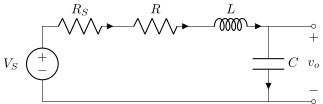
The objectives of this lab exercise are for students:
- To explore steady state circuit frequency response
- To deepen their understanding of RLC circuits
- To learn to better measure AC voltage with an oscilloscope
- To model real circuits and compare the theory and experiment
- To get a sense of resonance in a circuit
Materials
The following materials are required for each lab station:
- A function generator
- An oscilloscope
- A multimeter
- A breadboard
- Four male-male jumper wires
- A \(78\ \Omega\) resistor
- A \(100\) nF capacitor
- A \(10\) mH inductor
- One BNC Y- or T-connector
- One BNC cable
- Two BNC-to-alligator cables
Build the Circuit
The following steps describe how to build the RLC circuit of figure 1 on the breadboard. Note that the output resistance \(R_S\) of the source is internal to the function generator.
- Measure and record the actual resistance \(R\) of the resistor and capacitance \(C\) of the capacitor with a multimeter
- Measure the output resistance \(R_S\) of the function generator using the voltage divider method:
- Connect the function generator output directly to Channel 1 of the oscilloscope and measure the open-circuit output voltage \(v_\text{oc}\)
- Now connect the resistor \(R\) across the function generator output (creating a voltage divider) and measure both the voltage across the resistor \(v_R\) and the total output voltage \(v_\text{out}\)
- Set the function generator to output a \(1\) kHz sine wave with amplitude around \(2\) V peak-to-peak
- The output resistance is calculated as: \(\widetilde{R}_S = \widetilde{R}_L \left(V_S / v_{R_L} - 1 \right)\)
Build the passive portion of the circuit on a breadboard
Use the function generator as the voltage source \(V_S\). Its output resistance is \(R_S = 50\ \Omega\). Use a BNC T- or Y-connector to split the output of the output such that one cable connects directly to the oscilloscope's Channel 1 and the other connects (via alligator clips and jumpers) across the circuit
Into Channel 2 of the oscilloscope, connect another cable that has alligator clip probes connected to jumpers probing \(v_o(t)\)
Measure the Steady State Response at Different Frequencies
In steady state, this linear circuit with a sinusoidal input will have a sinusoidal output. The only difference between the input and output signals will be in amplitude and phase. It is these two quantities we will measure in each signal.
Set the function generator to a sinusoidal output around \(100\ Hz\) and record the actual frequency. (Take care that the output channel above the connector is pressed to turn it on!) Make sure you can see the input and output sinusoids, simultaneously. Measure and record the peak-to-peak amplitudes of the input (\(\widetilde{V}_S-\tilde{v}_{R_S}\)) and the output (\(\tilde{v}_o\)). Also measure and record the phase lag \(\phi\) between input and output1. (That's four recorded measurements, folks.)
Repeat these measurements and record the results in the table below for inputs near the input frequencies listed in the table (you don't need to be that close, just record the actual frequencies)
By fiddling with the input frequency, find a frequency that yields the highest output amplitude and make a final set of measurements at that frequency. Don't forget to include this in your data (it will be obvious in your report plots)
Tip for those using the BK Precision 2120B oscilloscope
If you're using the BK Precision 2120B oscilloscope, don't use the fine-tuning knobs on the vertical scale knobs of the oscilloscope. Instead, rotate them all the way clockwise until they "click" for calibrated voltage operation.
Tip for those using the BK Precision 4003 function generator
If you're using the BK Precision 4003 function generator, your frequency control isn't very precise, but don't worry: you can measure it easily by taking the reciprocal of the period on the oscilloscope!
Report Requirements
Write a detailed report of your experimental results, as outlined in the report template. Pay special attention to the following.
A thorough description of the theoretical analysis of the circuit using impedances. Make sure you derive the amplitude ratio \(r(\omega)\) of output over input as a function of source frequency \(\omega\). Also (along the way) derive the theoretical phase shift \(\phi(\omega)\) between input and output
A figure with the theoretical \(r\) plotted versus logarithmic frequency (use the measured \(R\) and \(C\) values) overlayed with the measured amplitude ratio \(\tilde{r}\) data
A figure with the phase shift \(\phi\) plotted versus logarithmic frequency overlayed with the measured phase shift \(\tilde{\phi}\) data
The other parameters measured in the lab (e.g. \(R\), \(C\), \(R_S\), and \(L\))
If using a BK Precision 2120B oscilloscope you will need to measure the time lag \(t_\phi\) and from this calculate the phase lag \(\phi\) with the formula \(\phi = 2 \pi f t_\phi\), where \(f\) is the frequency.↩︎