5.1 Analyzing the Diode Bridge Circuit
In the AC to DC lab, we will build and measure the response of a diode full-wave bridge rectifier circuit. This section is intended to introduce this circuit, used to convert AC signals to DC signals.
Figure 1 shows a circuit diagram for a full-wave bridge rectifier. Four diodes perform the rectification. A capacitor in parallel with the load effectively smooths this rectified signal.
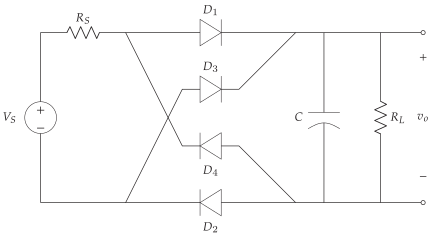
There are four diodes, so there are \(4^2 = 16\) possible diode states! We'll try to make good guesses and avoid invalid states in our analysis.
Analyzing the circuit
Let's begin by thinking about our diode model. Piecewise linear is our go-to. However, we can simplify it even further if we assume the load won't draw much current. The load in the AC to DC lab is \(1\) kΩ---so only small currents will flow through these diodes. We could go through the process of determining the current flow and choosing an operating point for diode resistances, but with such small current flow, we'd still be stuck setting all \(R_d = 0\).
So we choose to model the circuit as shown in figure 2. At this point we could perform a single analysis for the entirety of the circuit, but with the number of diodes, this gets messy. Therefore, we choose to reason our way through the potential states and analyze the few that survive.
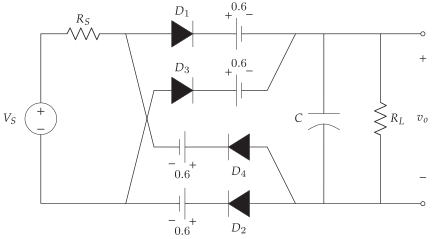
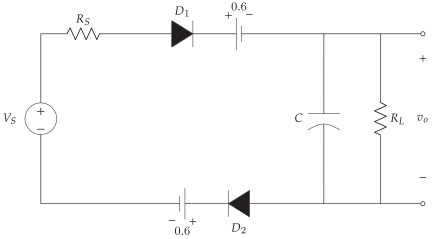
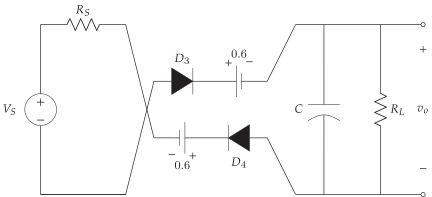
Consider the case of \(V_S > 0\). The only potential pathway for current is through \(D_1\) and returning through \(D_2\). It cannot return through \(D_4\), since its voltage drop will be negative. Similarly, current cannot flow from ground, through \(D_3\), to the positive side of the capacitor. That is, \(D_1\) and \(D_3\) cannot both be in forward-bias and neither can \(D_2\) and \(D_4\). A similar consideration of \(V_S \le 0\) shows that current can only flow to the load via \(D_3\) and return through \(D_4\).
Furthermore, we cannot have current flow to the load side of the circuit and not return, so we can eliminate any such cases. This leaves only three possible states.
- primary charge state \(S_1\)
- When \(D_1\) is ON, current must return via \(D_2\), so it must also be ON. \(D_3\) and \(D_4\) are off, corresponding to figure 3. So, using bold face for ON: \[S_1 = \left\{\begin{array}{lrrr} \mathbf{D_1},& \mathbf{D_2},& D_3,& D_4 \end{array} \right\}.\]
- secondary charge state \(S_2\)
- When \(D_3\) is ON, current must return via \(D_4\), so it must also be ON. \(D_1\) and \(D_2\) are off, corresponding to figure 4. So, using bold face for ON: \[S_2 = \left\{\begin{array}{lrrr} D_1,& D_2,& \mathbf{D_3},& \mathbf{D_4} \end{array} \right\}.\]
- discharge state \(S_3\)
- When all four diodes are OFF, the charged capacitor discharges into \(R_L\), corresponding to figure 5. So our discharge state is: \[S_3 = \left\{\begin{array}{lrrr} D_1,& D_2,& D_3,& D_4 \end{array} \right\}.\]
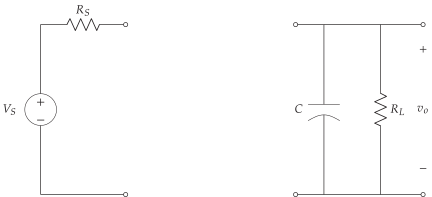
Let's consider each of these states as they arise from the initial time. As we do so, we can examine both the conditions that give rise to each diode state \(S_1\)--\(S_3\) and how the circuit behaves during each state.
Let's assume the capacitor begins uncharged. This isn't much of a stretch, considering that it has a load resistor to which it can discharge.
Let's also assume \(V_S\) increases sinusoidally from \(0\) V. At first, there's not enough voltage drop across \(D_1\) to turn it on, so we're stuck in the discharge state \(S_3\) until \(V_S\) increases enough to overcome both the \(0.6\) V associated with \(D_1\) and the \(0.6\) V associated with the return diode \(D_2\)---so when \(V_S > 1.2\). At that point, we transition to \(S_1\).
As \(V_S\) continues to rise, \(v_o = v_C = v_{R_L}\) increases---that is, the capacitor charges. When \(V_S\) decreases, the capacitor voltage doesn't immediately disappear, since its discharge into \(R_L\) is typically relatively slow. As the decrease in \(V_S\) continues, it will switch back to state \(S_3\), but this time before reaching \(1.2\) V because now the capacitor is still charged (although it is slowly discharging). Reconsidering the \(S_3\), we see that \(V_S > 1.2 + v_o\) for the diodes to be on. So we have now discovered that an alternative formulation for \(S_1\): \[S_1 = \{ V_S > 1.2 + v_o \}.\]
Let's consider development of output voltage during \(S_1\). In this state, we can analyze the circuit as follows. Here are the elemental equations.
| Component | Equation |
|---|---|
| \(C\) | \(\frac{d v_C}{d t} = \frac{1}{C} i_C\) |
| \(R_S\) | \(v_{R_S} = i_{R_S} R_S\) |
| \(R_L\) | \(v_{R_L} = i_{R_L} R_L\) |
Similarly, KCL and KVL give the following equations.
| Law | Equation |
|---|---|
| KCL | \(i_{R_S} = i_C + i_{R_L}\) |
| KVL₁ | \(V_S = v_{R_S} + v_C\) |
| KVL₂ | \(v_C = v_{R_L}\) |
Let's reduce this to a differential equation in \(v_C\), starting with the capacitor elemental equation: \[\frac{d v_C}{d t} = \frac{1}{C} (i_{R_S} - i_{R_L}) \tag{KCL}\]
\[= \frac{1}{C} \left( \frac{v_{R_S}}{R_S} - \frac{v_{R_L}}{R_L} \right) \tag{resistors}\]
\[= \frac{1}{C} \left( \frac{V_S - v_C}{R_S} - \frac{v_C}{R_L} \right) \tag{KVL₁,₂}\]
Therefore: \[\tau \frac{d v_C}{d t} + v_C = \frac{1}{R_S C} V_S\]
where \[\tau = \frac{R_S R_L}{R_S + R_L} C.\]
The solution to this familiar differential equation for initial capacitor voltage \(v_{C0} = v_C(t)|_{t = t_0}\) and input \(V_S(t) = A \sin(\omega t)\) is our output \(v_o(t)\).
The other charging state \(S_2\) is similar and yields the alternative formulation of \(S_2\): \[S_2 = \{ V_S < 1.2 - v_o \}.\]
The discharging state \(S_3\) is the easiest circuit to analyze: it is simply the capacitor \(C\) with an initial voltage discharging through the load \(R_L\), with no forcing.
Due to the nonlinearities, cycles through the states may be required before settling into a steady state. This relatively complicated analysis is sometimes bypassed by the method that follows in the next section.
A quick-and-dirty model
A full time-domain analysis of the circuit is preferable to this quick-and-dirty model, but this method is a nice way to quickly estimate the results.
The DC component of a signal is its average value. The average value of the signal across the load can be predicted if we know the maximum value of the rectified signal (sans capacitor) \(A_r\) and the ripple voltage \(\Delta v_o\), which is the steady state voltage from the high-to-low output voltage.
The maximum value of the rectified signal should be \[A_r = A - 2 \cdot 0.6,\] where \(A\) is the input amplitude and the \(0.6\) V term comes from the voltage drop across a diode.
Then the DC component of the signal should be approximately \[v_{DC} = A_r - \frac{\Delta v_o}{2}.\]
If we assume the ripple voltage \(\Delta v_o\) is relatively small and the AC signal has a high-enough frequency that it changes faster than the capacitor, we can assume that the full wave rectifier's output can be approximated by the expression \[\Delta v_o = \frac{i_{R_L}}{2 f C} \label{eq:ac2dc-approx}\] where \(f\) is the input signal frequency.
How do we know the load current \(i_{R_L}\) if we don't do the entire circuit analysis? It turns out that most loads for AC-to-DC conversions are actually voltage regulators, which draw steady currents. In the case of a resistor load, we can use a conservative estimate: the max \(v_{DC} = A_r\) (no ripple), so from Ohm's law the max \(i_{R_L} = v_{DC}/R_L\). Using the max \(i_{R_L}\) in the above equation yields the max ripple.1
This reasoning may appear circular: did we not assume the ripple was zero, then derive from that its maximum? In fact, we dropped the assumption that the ripple was zero once we derived the maximum current. This is an example of a bootstrapping method. We could actually iterate on this to get a better and better approximations, re-using better and better approximations of \(v_{DC}\) for better \(i_{R_L}\) for better \(\Delta v_o\) for better \(v_{DC}\), etc.↩︎